People assume the name is about wood. It is about weather.
In 1922 an American poet named Douglas Malloch published a short poem called “Good Timber”. It is not a famous poem. It is the kind that gets copied into notebooks and read at funerals and taped inside lockers, because it says one true thing without decoration:
Good timber does not grow with ease: the stronger wind, the stronger trees; the further sky, the greater length; the more the storm, the more the strength.
Douglas Malloch, “Good Timber” (1922)
The tree that has to fight for sun and sky and air and light, Malloch says, becomes the timber that holds a roof. The tree that “stood out in the open plain and always got its share of rain” never became a forest king, “but lived and died a scrubby thing”. Comfort makes scrub. When we were choosing a name for a brand strategy and creative agency in Lebanon in 2021, we did not need a metaphor for creativity. Lebanon had just given us a metaphor for everything else.
The country that taught us the word
Consider the years in which this studio was born. A financial collapse in 2019 that erased savings and salaries in a matter of months. A pandemic. On the fourth of August 2020, an explosion at the port of Beirut that damaged half the city and every assumption about safety anyone still held. Then, in 2024, a war that displaced hundreds of thousands of people and put strikes within earshot of our clients’ shops.
Every business that survived those years learned something that no MBA teaches: the plan is not the asset. The capacity to keep going when the plan dies is the asset. Lebanese-born Nassim Nicholas Taleb has a word for the extreme version of it, and it fits the country that produced him:
Antifragility is beyond resilience or robustness. The resilient resists shocks and stays the same; the antifragile gets better.
Nassim Nicholas Taleb, Antifragile (2012)
We watched brands get better in the storm. A sandwich chain that grew a young branch during the war, on a modest budget, because it stopped waiting for calm. A jewellery house that had sold seven thousand dollars’ worth of pieces in eight months of 2020 and closed the year with a campaign that brought in close to seventy thousand in five. An NGO that had lost a night’s donations to a crashed website and decided that the next site would hold, whatever the surge. Those three stories are our first three case studies, and they are the reason “endurance” is the word on our door rather than “impact” or “buzz”.
Rings, not leaves
Look at our mark. It is a cross-section of a tree, drawn by hand: a heavy outer ring, the pith off-centre, the rings uneven because the years were uneven. Everyone else in our industry shows you the tree in leaf, the handsome silhouette against a sunset. We reveal what time wrote inside it.
A ring is what a hard year leaves behind when the tree survives it. Narrow rings for drought, wide rings for good seasons, scars where something struck and the wood grew around it. You cannot fake a ring and you cannot rush one. That is exactly how a brand’s reputation works. Warren Buffett said it about companies, and it is truer of brands:
It takes twenty years to build a reputation and five minutes to ruin it. If you think about that, you’ll do things differently.
Warren Buffett
Doing things differently, for us, means a creed we repeat until clients repeat it back: roots before reach, depth before noise, meaning before marketing. Not because attention is bad. Because attention without foundation is the most expensive thing a company can buy, and we have watched too many buy it. We wrote a whole essay on that: Roots over noise.
The house
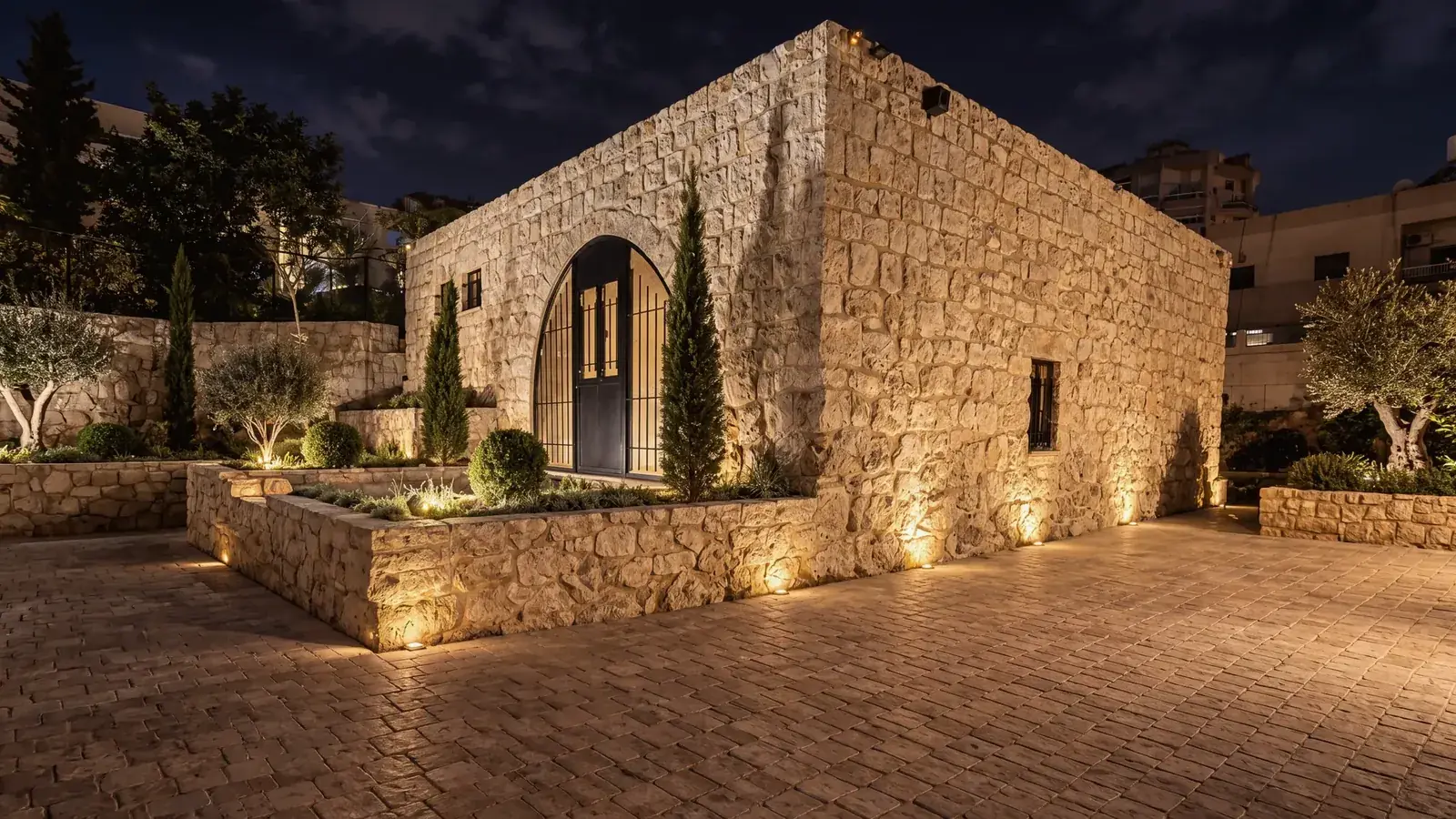
We work in a stone house in Adma, above the coast north of Beirut. It was built with vaulted ceilings by people who expected it to outlast them, and it has. The walls are half a metre thick. The rooms stay cool in August without much help. We did not choose it for the photographs, although it photographs well. We chose it because it keeps us honest about what “built to last” actually means when you are the one who has to build it.
Some agencies rent an office. We keep a house. It is small on purpose: a few brands a year, chosen for what they are building rather than how loud they are, and every one of them gets the whole house. When we hire, we look for the same thing we look for in a client: someone who wants to grow roots, not someone who wants to be seen growing.
Resilience as a service
Here is the part that matters to a CEO reading this in Beirut, Dubai or Riyadh. Resilience is not our mood. It is a set of things we do to a brand so that the next shock is survivable, and it is the most under-priced service in marketing.
- Distinctive assets that hold. A mark, a colour, a line, a sound that people can recognise in half a second, kept consistent for years. When the market panics and budgets shrink, the brand with distinctive assets keeps being remembered for free. The brand that redesigned itself every season starts from zero.
- A positioning that survives a price war. If the only reason to buy you is price, the first competitor with deeper pockets takes your customers. A clear position gives people a reason to pay a little more and to come back when the discount war ends.
- Media discipline. Money spent on brand building during a crisis is the cheapest brand building you will ever buy, because your competitors have gone quiet. We plan budgets so that a shock does not mean silence.
- Systems that do not fail on the important night. A website that takes the surge. A sales team that knows what the ad promised. Customer service that can absorb a crowd. Glamour is optional; capacity is not.
- A story that is true. The brands that came through the last five years with their reputation intact were the ones that did not pretend. Kahlil Gibran, another Lebanese who understood storms, said it with more grace than any strategist:
Out of suffering have emerged the strongest souls; the most massive characters are seared with scars.
Kahlil Gibran
A brand with scars it can talk about is a brand people trust. That is not a slogan we wrote. It is a pattern we measured across every client we have kept.
What this means if you are choosing an agency
Choose one that has been through weather. Not because suffering is noble, but because judgment is formed there. An agency that has only worked in easy markets will give you easy-market advice: spend more, post more, trend more. An agency that has kept clients open through a collapse, a pandemic, an explosion and a war has learned which levers actually hold when everything else moves.
We are that agency, and we are honest about the cost of having become one. Good timber does not grow with ease. If your brand is standing in the wind right now, in Lebanon or anywhere in the Gulf, we know the ground. Come and talk to us.